News
Barcelona nature-based solution field trip
3 June, 2024
By EQN steering group member, Magali Thomson

I recently had the opportunity to visit Barcelona on a study-trip focusing on nature based solutions, and was able to experience first-hand some of the dramatic changes that have taken place in the city. Barcelona is no stranger to innovation and has always been open to adapting and reinventing itself in response to new challenges. Historically the Barcelona 1859 Cerda spatial expansion plan was a response to what was essentially a health risk, with the population of Barcelona no longer able to be contained within its city walls. Cerda, an unknown engineer, proposed a city expansion based on an orthogonal grid, uniting the city with several peripheral villages, called the Eixample. His approach was revolutionary at the time: He calculated the volume of atmospheric air one person needed to breathe correctly. He detailed professions the population might do, and mapped the services they might need, such as marketplaces, schools and hospitals. He concluded that, among other things, the narrower the city’s streets, the more deaths occurred. Forward thinking components of 21st century concepts such as the 15-minute city which thrives on proximity, as well as health as a metric to success, underlying his approach.

Cerda Plan, Source: Archivo Historico Municipal de Barcelona
Since then Barcelona has been through several other urban iterations, including the 1992 Barcelona Olympics, which successfully reconnected the seafront to the city, and more recently the reinvention of the industrial Poblenou district, where underused land and industrial buildings are being re-used to create a new tech hub for innovative technology companies called 22@.
This is where we started and ended our study-trip learning from Jaume Barnada (Management of the Chief Architect, City Hall of Barcelona) about the city’s ambitions to: increase people’s access to nature, reverse the vehicle pedestrian hierarchy to 70% in favour of pedestrians, and the city’s Superblocks programme.
This programme groups together nine city blocks and closes them to through traffic providing play areas and green spaces, and car access is limited to servicing and people who live in the block. Alongside these projects he described a number of evaluation exercises being carried out to measure the success of these interventions, including the ‘Salut als Carrers’ project (Health in the Streets) which evaluated the health and environmental benefits of three of the city’s Superblocks.

Superblocks Model Source: Ajuntament de Barcelona
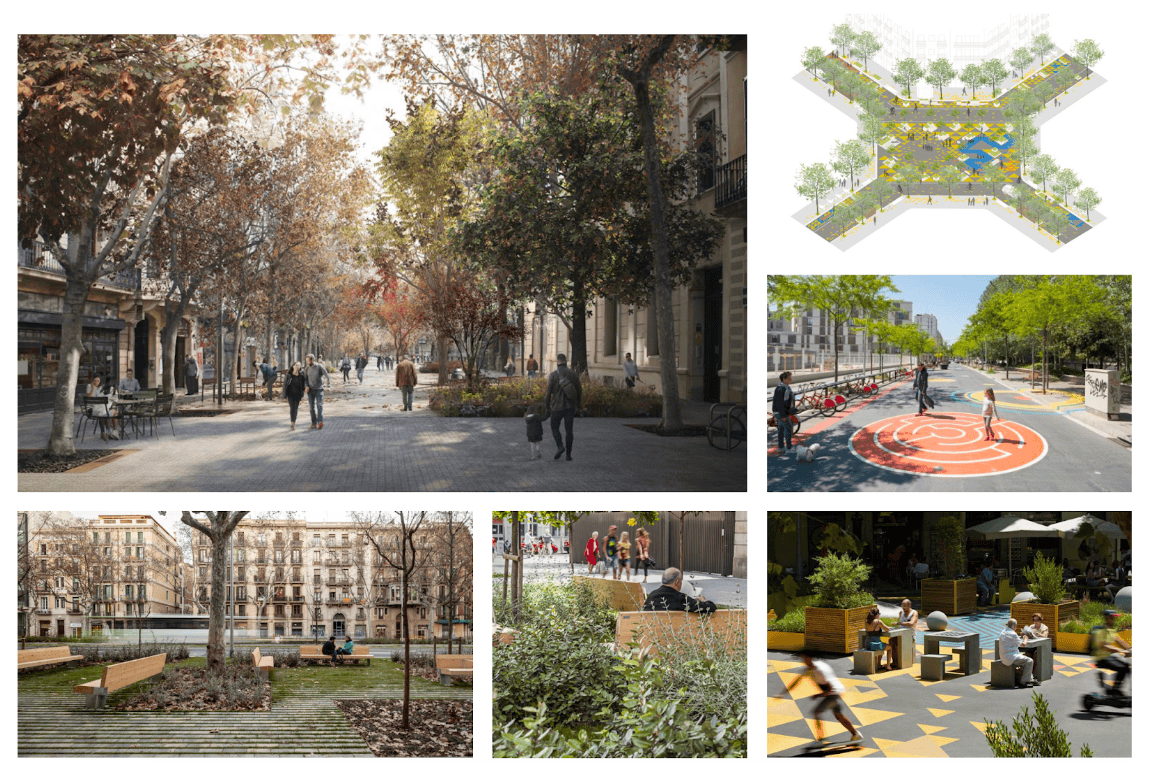
As is often the case however, we learnt the most in our walks through the city, with three areas standing out in particular. The first one was a walk down the length of Consell de Cent which is one of the west to east axis streets which form the Eixample. This was transformed in record time last summer, due to the team wanting to get the project completed before the mayoral elections. A number of climate resilient measures have been introduced such as an increase in greenery and planting (from 1% to a minimum of 12%); hard surfaces have been replaced with permeable ones which can filter rainwater and use it to water the nearby planting beds; 438 new trees in the whole area, as well as multiplying the number of benches, children’s games and fountains.

I often find there is confusion in areas where shared surfaces have been installed. Blurring the boundaries between pedestrian and vehicular areas without enough clarity with respect to which takes precedence. However, there was no room for confusion at Consell de Cent as the balance has tipped so unequivocally in favour of the pedestrian, that it is the car, tied to a 20km speed limit, that is left to timidly advance. In fact it is regularly described by Judit Sanz, deputy Mayor of Urbanism as follows: “the vehicle ceases to be the king of public space and becomes a guest”.
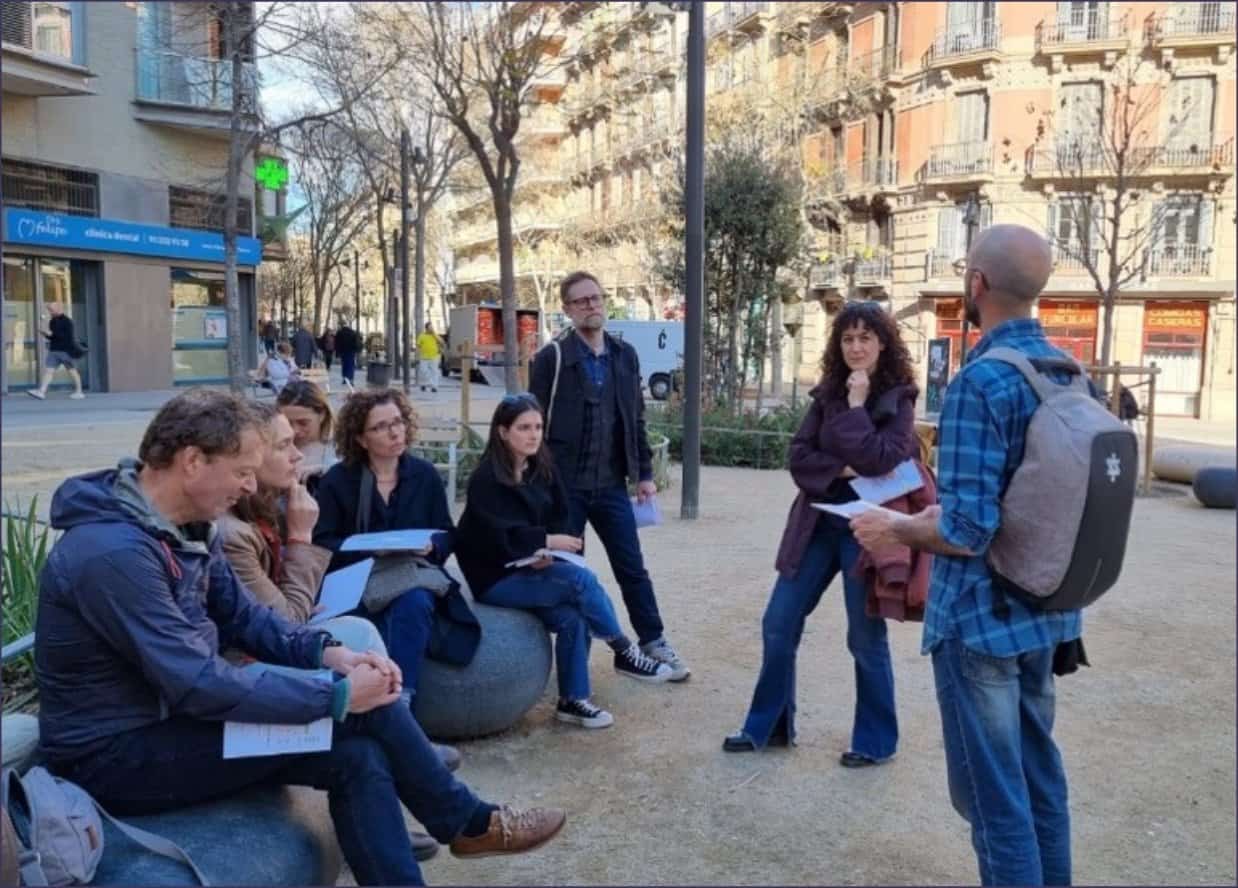

Equally inspirational was a visit to the Eje Verde (Green Corridor) Cristóbal de Moura which forms part of the newer 22@ tech area, including some carefully renovated industrial buildings. This is a smaller scale intervention which provides stormwater management through sustainable urban drainage. It is an extensive area providing a wonderful green environment to a variety of work spaces which surround it, and which stands out due to it delivering so much more than sustainable water drainage. The co-benefits are extensive, ranging from increasing biodiversity, improving accessibility to green space and cleaner air, to the educational value of the project, beautifully demonstrated by clear and accessible information boards describing the project. Bearing in mind that during our visit the drought which Catalonia is undergoing was highlighted to us several times, it was remarkable to see how healthy and green the area was looking.
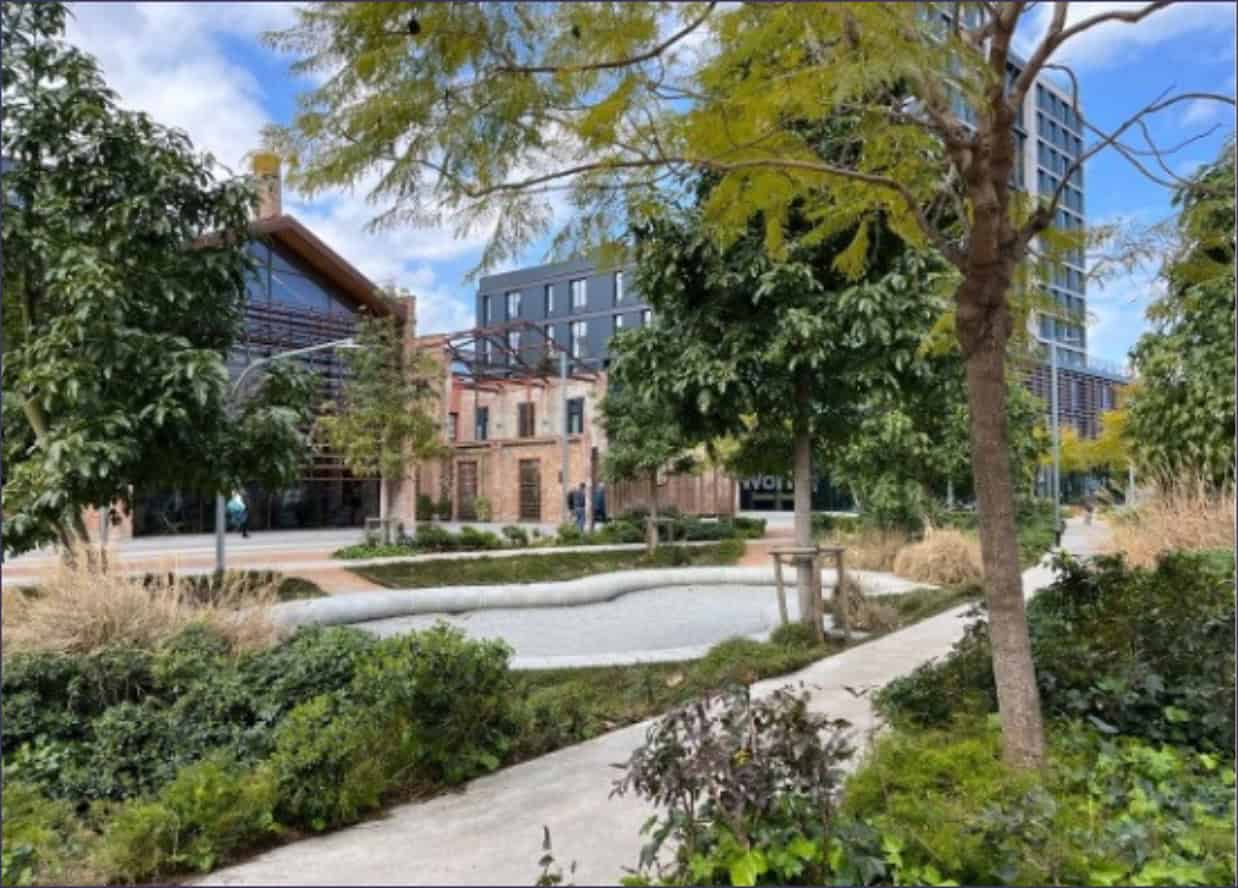
Eje Verde (Green corridor) Cristóbal de Moura
A session on our final day at the ISG Global main office, brought us back round to conversations about healthy places, and the benefits they provide, with presentations illustrating the urban determinants of health and how healthy neighbourhoods help foster healthy lives. A clear commitment to scientifically illustrating the health, social and economic value of sustainable and healthy urban development underpins ISG Global’s work, and they are an inspiration in terms of clear, informative and accessible data.
The values that underpinned the various projects we visited, and talks we listened to were both their climate resilient credentials and human-centred objectives. However, they go beyond this, delivering a whole gambit of benefits, and ultimately creating beautiful, healthy places for all, that people want to spend time in. Which is what it’s all really about. Barcelona is an exemplar city illustrating what can be achieved with strong mayoral leadership, and the confidence to be experimental and innovative, resulting in a city which keeps reinventing itself, which is a joy to be in.